Can we understand languages not merely by their grammatical structures or linguistic families but by how they resonate within us? Why do we feel fluent in a language? How does this pure abstraction that we call language transmute into a deeply tactile experience?
Some languages invite us to gather on uncharted ground, drawing together unexpected companions and bridging distances. Others are rooted deeply within us, woven into the very fabric of our being, shaping the muscles we use to speak, carried by the breath that transforms into words moving in and out. They deny any gap between the words and the flesh of the world. Others offer a more calculated form of expression, composed and controlled—a language we recite, memorize, and repeat from textbooks. This is a language of precision with an accuracy founded in our conscious engagement with words learned by the rules. It is in this latter schooled language that I write about Still in My Quotidian (2024), a performance by the collective Yani—not only because English was the language of the performance but also because the work demanded a distance from it, as I remained unfamiliar and unprepared as a latecomer.
Formed by Siwar Krai(y)tem, Alev Ersan, Betül Aksu, and Hanieh Fatouraee during the BAK Fellowship for Situated Practices, the collective begins with a word that echoes across the languages spoken by the group members: “yani.” This colloquial term, used for clarification, explanation, or emphasis, embodies an attempt to bridge the gaps between what is said and what is meant, even as it acknowledges the impossibility of fully doing so. At least, as a “native” Turkish speaker, this is how the word resonates with me. “Yani” reflects a struggle for mutual understanding.
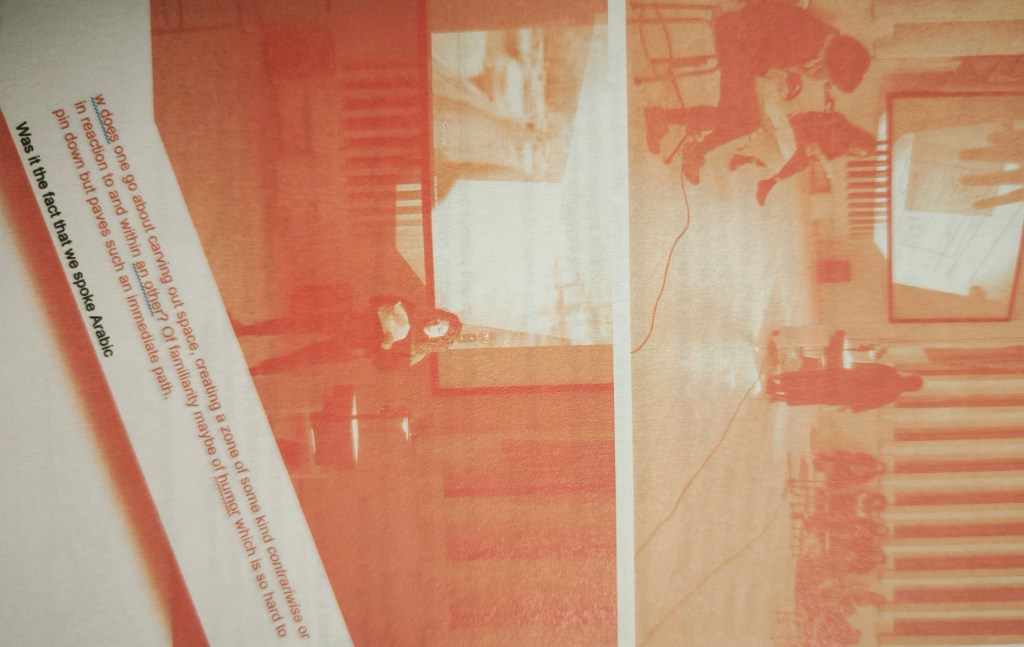
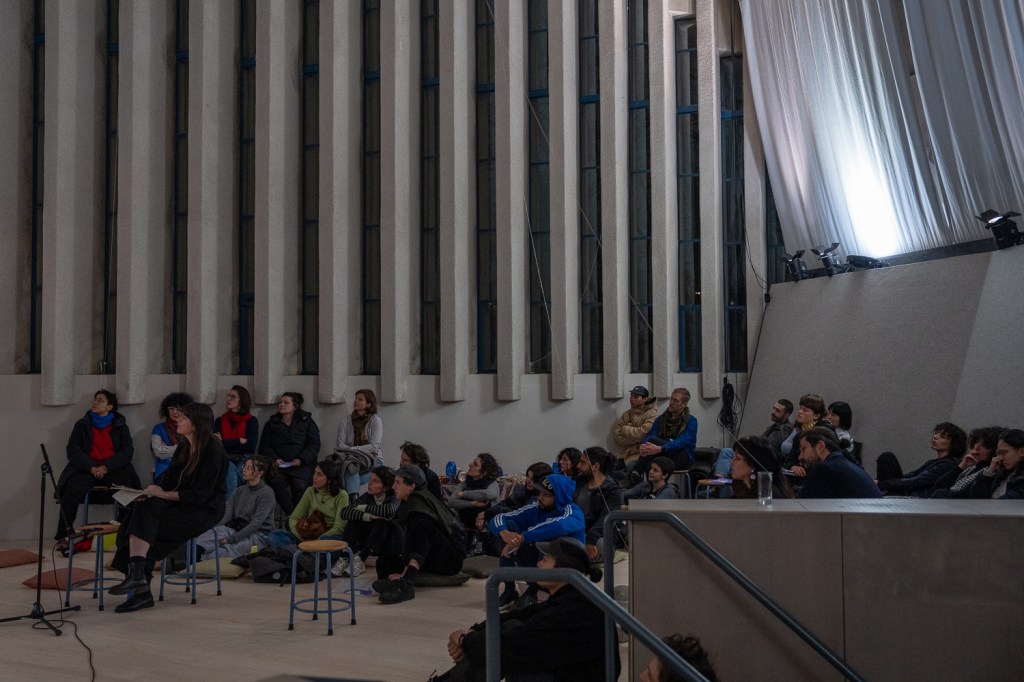
This tension is also central to Still in My Quotidian, the lecture performance at de Appel, which meditates on the presence of a tactile and homegrown language in absentia, tainting the intended meanings in an acquired second language. The performance unfolds beneath the dome-like structure of de Appel, with the performers surrounded by the audience. Some of us sit on pillows on the ground, others perch on chairs. In this semicircular setting, we observe not only the performers but also the audience across. There is no stage—no architectural element physically separating performers from spectators. We all share the same ground, heightening the sense of a common experience that feels intimately familiar to each of us in some way. Our gaze moves seamlessly between the performers and the audience; at least in the beginning, no firm divide exists between us. I sit in a chair, having agreed to livestream the performance for Hanieh, who was unable to be present at the performance due to visa issues. I hold the camera in my hand and try to remain still.
The Many Meanings of Stillness
Krai(y)tem explains that “Still” denotes the endurance of the mother tongue, even when removed from the motherland (2024, public talk). The mother tongue lingers as a silent force, haunting daily life, while the schooled language remains unbeknownst to the meanings and feelings one wishes to convey. Still in My Quotidian explores the affective dimensions of language, transcending its role as a mere tool for meaning-making. It delves into the affectionate words one grows accustomed to and everyday structures embedded in sentences, which are disrupted by adopting a second language. This acquired language is learned by vocalizing letters from a page, tracing those distant symbols on blackboards, whiteboards, or through the lights of an overhead projector in class. Mispronunciations and accents that linger on the proper sounds of words leave a sense of failed presence. The now-distant home appears as a deviation within this language of everyday communication.
I remember my very first German lesson when I started secondary school. We had to pronounce the familiar “z” correctly in German. The class tried to perform a “t͜sɛt” as a chorus, but to no avail; each time, the teacher confirmed our inability to do so. Maybe some of us managed to get it right, but we were lost in the collective voice. I now wonder about the moral of the lesson: Will you ever truly belong to this world that seems familiar but resonates differently in your lungs, throat, and mouth? Speaking and unflowing in a foreign language highlights a more profound, native inability to convey the meanings with the words I once navigated so confidently in life.
The anxious gap between what I say and how I am heard betrays me. Yet, it also betrays the very language I attempt to speak. English serves as the host, but it is colored and, at times, violated by Yani‘s accents. It becomes a ubiquitous “landscape” and a “linen fabric” draped over their conversations, with an invisible yet rough texture (Ersan, 2024:33).
A Letter to a Mother Tongue
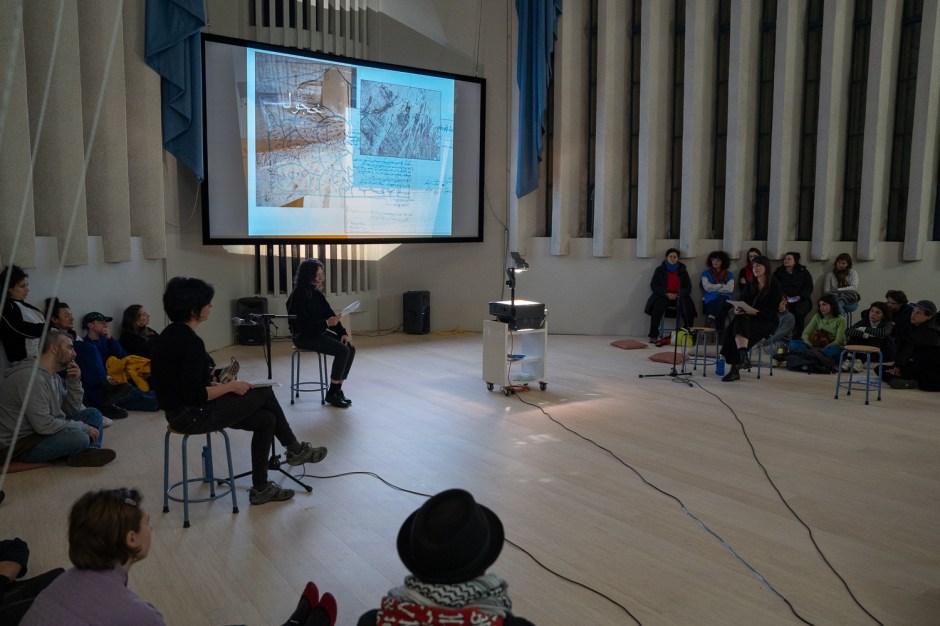
The performance begins with Krai(y)tem reading a letter she has written to her mother tongue, Arabic—a letter composed in English but spoken with a voice shaped by Arabic sounds. Her words materialize as opaque images on the screen while colors and lines build layer by layer. The projected images become a stage for a shadow play, filling in the gaps left by language and gesturing toward the limits of what can be expressed.
The presence of the bulky, mechanical overhead projector contrasts with the forgotten source of the digital images. The performers move words and images with their hands, transforming them into tactile forms that transcend flatness, fleshing out the words. The digital images projected on the screen mark the borders of these missed encounters—an aspiration to go beyond the surface of foreign words that help navigate the daily humdrum but prevent a deeper dive into their essence.
The play of hands on the glass surface of the overhead projector reflects a desire to shape and connect with these distant words. Krai(y)tem occasionally shares moments in Amsterdam where she encounters her mother tongue, transporting her from the unaccustomed spaces of the city into the corporeal memories of a distant place. The texture of these missed words is not confined to textbooks but rooted in lived experience, embracing and haunting this distant secondary language.
Krai(y)tem’s letter hosts similar stories of Aksu, Ersan, and Fatouraee. As they narrate their relationship with the language, the mother tongue resonates at a different layer each time. They dig into Krai(y)tem’s letter, reciting their texts cruising through their quotidian experiences. This letter to the mother tongue becomes an excavation site, where Aksu and Ersan delve deeper, following Krai(y)tem’s lines toward shared understandings. Each performer reveals the letter’s layers of language, anchored in a sense of belonging within an “exteriorized tongue” (Ersan, 2024: 35). The language one learns to speak, seeks to speak, longs to speak, and fails to speak.
The Asymmetries of Hospitality
This acquired language serves as a host for the mother tongue that haunts quotidian experiences, leading me to consider the terms and conditions of the acts of hosting and haunting that prevail as a pretext in the performance. Anne Dufourmantelle (2013) highlights the common etymological root of the words “host” and “hostility,” both anchored in the Latin word hostis. This word refers both to the “inviting” master and the “invited” guest, with a twisted etymological journey leading towards the concept of “hostility” (2013:14). Hence, the seemingly altruistic meaning of hospitality takes on a darker connotation, especially when we are the ones to decide on how to host and define the “other.” Dufourmantelle notes, “the minute we assume that we are the ones who belong, while the other does not … a power game sets in” (2013:16).
There is no such thing as unconditional hospitality, as the Maussian gift economy suggests. A gift expects a return—whether it be a favor, another gift, or at least an enduring gratitude. The conditions that dictate whom we choose to host and whom we exclude already constitute an act of violence, as Dufourmantelle remarks. The host keeps the guest as a “hostage,” subjecting them to its own rules. The one who enters the house of the other agrees to abide by the polite rules of this power dynamic. Thus, there are always limits and conditions to hospitality.
Hospitality is a central theme in the practice of Yani. In the lecture-performance, language is declared as a host. An artist’s domestic space becomes the host in a subsequent, private act. In “Research Interrupted” at BAK, their publication serves as the host. Each scenario examines how they occupy spaces without fully settling, being temporarily hosted yet potentially held hostage by these transient conditions. The English language acts as the constant host, subtly infusing every interaction with its presence and framing each encounter within this primary, underlying structure.
During the performance, Ersan, Aksu, and Krai(y)tem sit apart on the stage, each perched on a chair. The distance between them becomes the scene for occasional moments of connection as they wander, meet, and draw near, sometimes whispering to each other nearby. Their bodies seem haunted by the written words on paper, their eyes fixated on the lines, almost blinded by the text. Waiting for their turn, they silently follow each other’s words. At times, the images on the screen draw our attention away from the stage. While they read their scripts, these images pull us in different directions, yet the physicality of their voices resists the flatness of the screen. The act of reading aloud from a page introduces a distinct rhythm, one that contrasts with the spontaneity of spoken language. The performance reveals a voice that is not a direct encounter but one mediated by text—a letter read in a monotone voice, allowing listeners to shade its meaning with their own experiences.
Aksu’s response to the letter manifests through acts of highlighting, repeating, and reciting specific passages. She emphasizes key points, directing the gaze and attention, marking where the letter resonates with others. Instead of focusing solely on Krai(y)tem’s narrative, she employs a reading that defamiliarizes the language through repetition, revealing the language’s structure and the narrative’s conditionality. While her reading may appear as a structural intervention, it carries the traces of a guest’s hesitance into another’s home—the boundary work of hospitality. Aksu navigates Krai(y)tem’s text with care, overwhelmed by its openness and cautious of her precarious position, much like someone granted “limited leave to remain… as long as the conditions are met” (reflecting the language of UK visa requirements). In this stillness of doubt, Aksu’s ongoing work on the regulations governing movement across borders raises questions about the limits of welcoming the other. The act of hospitality serves as a reminder that you are an outsider. It is both a heartwarming offering and a challenge to pursue acceptance.
In this sense, the structural intervention reveals the rules of hospitality and hostility that frame the “other” under the disguise of English grammar. Language becomes the medium through which the guest, the other, and the latecomer engage in a conditional relationship, echoing the boundaries of “limited leave to remain.” Aksu disrupts Krai(y)tem’s letter with the recurring sounds of “on,” “or,” and “of.” The subtle consonant shifts, paired with persistent vowels, create a stuttering rhythm, gradually indicating that she is undoing meaning by focusing on words until they lose significance.
of or occurring everyday; daily.
| of | or |
(Aksu, 2024: Still in My Quotidian)
The Legacy of the Language
Aksu prefers staying on the surface of words, particularly when we first encounter a foreign, unfamiliar word. One might obsessively search for the rules within this secondary language, yet the host’s rules remain elusive, often rife with exceptions. When Aksu repeats the word “quotidian,” it feels as though she is recalling her initial encounter with it, facing the surface of the language directly. She spells the word slowly, like dissecting a strange piece of fruit to fit it into her mouth. The tongue must twist in new ways, following an unprecedented path. This unfamiliar word reanimates the life-forming air, catching the breath unbidden.
Language, as an undeniable embodied inheritance, leaves its mark on every word we utter and in every breath we cast in words. This inheritance becomes particularly audible when we speak in another language. As Ersan quotes the poet Rita Wong, if we remain quiet enough to listen, we might hear this legacy: “… are you quiet enough to hear the beautiful, poisoned ancestors surfacing from your diaphragm? The reigning voice resigns or resignifies” (2024). This legacy resigns, reigns, and resignifies in each breath.
When we hear Aksu’s voice for the first time, we notice a tremor in her spoken words, hesitating as if on the verge of stuttering—perhaps a moment of resignation from the self-assuredness of a reigning language. Either way, it feels like a resignation from the self-confidence of the reigning language, a homecoming into an unfamiliar language bound to be always broken. Yet this intermittent voice appears to be her way of entering Krai(y)tem’s letter, responding to the invitation to be hosted by a text while becoming a hostage to language. She repeats, recites, and tears down the language into its components. By breaking words down into their grammatical units, she transforms this tongue twister into manageable parts. The “ancestors surfacing from your diaphragm” resist being swallowed, allowing the sounds of the strange word to emerge. The stutter on her words sounds like this air at the threshold, embodying the heritage settled in the spoken words.
The Rules of the Ruling Language
This fragmentation of the proper sound of English in the hesitant stutters of a stranger is echoed in the British Airways planner, filled with recipes in handwritten Arabic. As we watch Krai(y)tem leaf through this family heirloom, Arabic letters rise against the rigid, ruled lines of the English planner. The legacy of the mother tongue, seasoned with these recipes, appears on the pages of this commercial freebie, reminding users of a history written by British rule. Time, measured by bank holidays and historical events in British history, is disrupted by the recipes of Krai(y)tem’s grandmother, offering an alternative of temporality.
“How graciously you sit there, colonizing the British planner with your beautiful letters. Very composed, sitting perfectly on those rigid lines. You look so confident being there, occupying bank holidays and weekends alike, claiming the rightful amount of space on the vast- now quite yellowish pages (Krai(y)tem, 2024).”
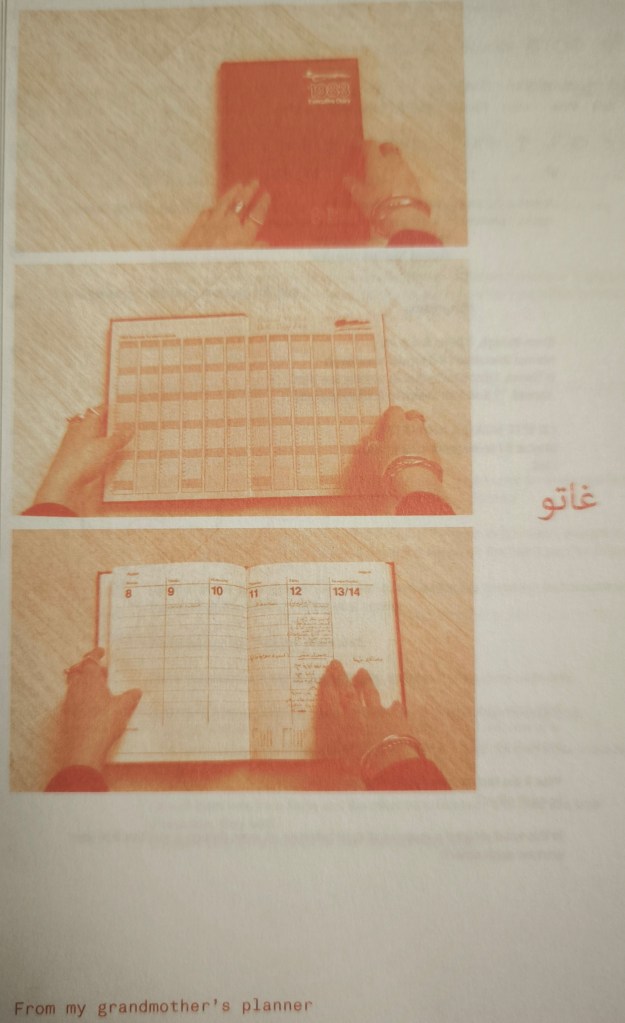
While the days are cast into the figures of ruling history, with landmark events conquering the minutiae of time for its subjects, these recipes measure things in handfuls, mouthfuls, and spoonfuls. The handwritten words of the recipes, embodying their measurements, rise against the rigid lines of mechanical letters. The projected timeline of the planner is disrupted by the elegant, twisted handwriting that conveys the taste of the mother tongue. The Arabic letters cast a spell on the colonizing power of English, occupying its rules and sound foundations.
In another moment of the performance, the colonial power of the native English accent resurfaces at a dinner table. Fatouraee reflects on his brother’s disdain for his foreign accent when speaking English, to which her inner voice responds: “I didn’t have the energy to give them a speech on colonialism.” Mastery of the foreign tongue’s native cadence further complicates things, blurring the boundaries of mother tongues. As new sounds take shape, the language’s grammar—its structural bones—pricks at the flesh.
From Hanieh Fatouraee’s letter, voiced in her absence through the projected images, we learn that her competence in Turkish receives compliments for its “native” sound. This praise for her fluency makes her uneasy, as the proper sound of a language can serve as a marker that delineates belonging. Thomas Claviez [1] underlines the riddle of what we consider proper and appropriate about who has the right to a place: “The concepts of what is ‘proper’ and what is property—and thus, what ‘belongs’ to me, and what is thus the (imperative) property I need to offer ‘proper’ hospitality collides with what might be the ‘appropriate’ thing to do” (2013: 35). Language is embedded in this proper place, shaping an “auditory geography” [2] (LaBelle, 2014) through its rhythms, histories, and etymologies.
The Taste of the Language
This layering is vividly illustrated in Ersan’s etymological exploration of إكي دنيا (ikki dunya), the many names of the fruit Krai(y)tem purchased in an Amsterdam market. Ersan’s inquiry traces the twisted paths of words across borders, languages, and cultures. She delves into the depths of letters and words, exploring common and uncommon words and searching for her homebound words in Krai(y)tem’s homeward vocabulary.
The etymological survey of the “Maltese plum” continues to the Levant: also
ekkadeneh
eskidinya
akka dhunya
akkidinya
ıgadinya
meaning, the old world
The taste of the language that Krai(y)tem misses fleshes out once again as she recalls the “old” taste in “yeni dünya,” or “the new world.” The old (eski) and new (new) worlds collapse as the yellow fruit in the market evokes “another tactile experience” that Krai(y)tem longs for.
As I hear these familiar, homebound words amidst the English-spoken performance, I’m momentarily drifted to the “old world,” as if recognizing a secret code that binds us together and creates a moment of mutual recognition. For second-language speakers, exchanging words from neighboring languages becomes a bonding ritual—a playground of shared, curious meanings. Discovering common phrases, tastes, and expressions draws us closer across linguistic divides.
Nicoline van Harskamp asks, “Whose language do we choose to use when we have no first language in common?” (2021: 150). [3] While the English language serves as a colonizer of everyday experiences, it is paradoxically also the very medium through which we forge friendships, kinships, and other forms of solidarities across borders. Multilingual rapper Saint Levant captures this split character of this language: “I hate that. I’m more comfortable in English.” [4] The everyday politics of language emerge here, where power dynamics shape how individuals express themselves and how they are heard. One’s mother tongue twists and bends toward this second language in the quest to be heard, which is foundational for creating connections and alliances. Saint Levant’s disdain becomes an acknowledgment: “But every day I tell myself that it’s a privilege cause I can talk about the way my people and I know you want to listen.”
Singing in English, Arabic, and French, Marwan Abdelhamid, known as Saint Levant, carries his English as a reclaimed missionary tool to tell homebound stories. Speaking in this uncommon language to connect with one another is, disturbingly, the only way to listen to stories beyond dominant narratives. Bitter yet hopeful, Saint Levant reconciles with the many layers of English— a language that grows “homeless” in its effort to host the world of mother tongues and their stories. At this point, we might argue that English becomes homeless to host the other while simultaneously hosting the affective world of its users’ mother tongues and their myriad homebound stories.
Aksu, Fatouraee, Ersan and Krai(y)tem each leave the intimacy of their mother tongues to approach one another, breaking the sounds and meanings of English in multiple ways. The fragmented nature of this broken language signifies the shortcomings of the latecomer, yet it is also how a new sense of home sounds for many. This fragmented language refracts the homebound language.
The word “yani,” in this sense, refers to the constant work of explanation and marks the unavoidable detour from singular meaning. In the performance, this work translates into a restless chatter or a never-ending search for the origins of words, tracing their journeys across distant geographies. In the former case, the burden of language is alleviated with more words—there is no room for pauses or silences. This verbosity highlights a profound disbelief and misbelief in a language caught in between. As we search for balance between the two worlds appearing on the horizon, we are caught between conflicting orders of life.
This swelling and proliferation of language -compensating for the lack of words with an abundance of them- is succinctly captured by Zygmunt Bauman, [5] a prolific exiled writer: “There is always something to explain, to apologize for, to hide or on the contrary to boldly display, to negotiate, to bid for and to bargain for; there are differences to be smoothed or glossed over, to be on the contrary made more salient and legible” (2004:13). Still in My Quotidian narrates the attempts to break, reclaim, and reshape this borrowed tongue, breaching borders and unveiling the unwritten rules of hospitality. New forms of solidarity and kinship emerge through failure, fragmentation, and misunderstanding.
At the end of the performance, we speak with Alev, reflecting on our mother tongues, father tongues, and the other home-bound languages we cannot speak. We share our experiences of growing up in multilingual households. I speak neither my father’s language nor my mother’s. She calls me “non-lingual.” This word lingers with me ever since. Perhaps this is where my relentless interest in the unfamiliarity of language rests. The primordial language becomes a soundscape devoid of literal meaning yet predominantly a tactile experience. It is never purely homely nor entirely hostile but rather diffracted, stratified, dubious, and fragmented, keeping one always at the threshold.
For more of Esra Oskay’s writing, please see Çapak Dergi.
Endnotes:
[1] Claviez, T. (2013). The Conditions of Hospitality: Ethics, Politics, and Aesthetics on the Threshold of the Possible. Fordham University Press.
[2] LaBelle, B. (2014). Lexicon of the Mouth Poetics and Politics of Voice and the Oral Imaginary. Bloomsbury Publishing.
[3] Harskamp, N. (2021). in Toward the Not-Yet: Art as Public Practice, 2021, Jeanne van Heeswijk, Maria Hlavajova and Rachael Rakes (editors). BAK Utrecht and MIT Press.
[4] Saint Levant (2022). https://www.tiktok.com/@saintlevant/video/7153335930437405998?lang=en
[5] Bauman, Z. (2004). Identity: Conversations With Benedetto Vecchi. Polity Press.

